
-
Editor(s):
Professor Kim Talus
CCEEL, UEF Law School, University of Eastern Finland (UEF)
-
OGEL 1 (2024) - Climate Litigation and the Energy Sector
This Special Issue aims to provide an energy perspective on climate-related litigation, covering topics such as Greenwashing, Accountability, GHG, (Environmental) Disputes, Investments, Renewable Energy, Role of the Court, and more.
Table of contents - Climate Litigation and the Energy Sector
Special features
Each issue of OGEL can have one (or more) special features on a topic of interest, see the overview below.
If you have suggestions for new topics, or would like to take the opportunity
of acting as guest editor for a special issue do contact us.
See our call for papers section for an overview of
the topics that we will address in the near and longer term.
Special features
Click on one of the links below for a full table of contents of the issue. For an author profile you can click on the name of the Associate Editor(s).
2024
2023
- OGEL 5 (2023) - The Impact of the War in Ukraine on the Energy Sector
- OGEL 4 (2023)
- OGEL 3 (2023) - Carbon Capture and Storage
- OGEL 2 (2023) - Energy Market Creation: Liberalisations and Transformations
- OGEL 1 (2023)
2022
- OGEL 5 (2022) - Offshore Energy Investments and Activities
- OGEL 4 (2022) - Carbon Neutral Energy
- OGEL 3 (2022)
- OGEL 2 (2022) - Law and Policy for Gas Flaring in a Low-carbon Economy
- OGEL 1 (2022) - The EU Fit for 55 Legislative Package
2021
- OGEL 5 (2021) - COVID-19 and the Energy Transition
- OGEL 4 (2021)
- OGEL 3 (2021) - Review of the Energy Sector in Ghana
- OGEL 2 (2021) - The Hydrogen Economy
- OGEL 1 (2021) - Energy Transitions
2020
- OGEL 6 (2020) - Law and Policy of Energy Storage
- OGEL 5 (2020) - Environmental, Social and Governance (ESG)
- OGEL 4 (2020)
- OGEL 3 (2020) - Changing LNG Markets and Contracts
- OGEL 2 (2020) - Regulation of Petroleum Development in Guyana
- OGEL 1 (2020) - Social Licence to Operate (SLO) in the Extractive and Energy Sectors
2019
- OGEL 5 (2019) - Natural Gas Pipeline Construction and Regulation
- OGEL 4 (2019) - OGEL/TDM Special Issue: FDI Operations and Investment Disputes in the African Extractive Sector...
- OGEL 3 (2019) - The Energy Union in the Next Decade
- OGEL 2 (2019)
- OGEL 1 (2019) - Energy Law and Regulation in Low-carbon and Transitional Energy Markets
2018
- OGEL 5 (2018) - OGEL/TDM/ArbitralWomen - Strategic Considerations in Energy Disputes
- OGEL 4 (2018)
- OGEL 3 (2018) - International Energy Law
- OGEL 2 (2018) - Decommissioning Offshore Energy Installations
- OGEL 1 (2018)
2017
- OGEL 4 (2017) - Liquefied Natural Gas (LNG)
- OGEL 3 (2017) - Energy Law and Policy in the Middle East and North Africa (MENA)
- OGEL 2 (2017) - Brexit
- OGEL 1 (2017) - Oil and Gas Law and Policy in West Africa
2016
- OGEL 4 (2016)
- OGEL 3 (2016) - Waste-to-Energy (WtE)
- OGEL 2 (2016) - Emerging Issues in Polar Energy Law and Governance
- OGEL 1 (2016) - Mexico's Oil and Gas Sector Reform
2015
- OGEL 6 (2015)
- OGEL 5 (2015) - Yukos Special
- OGEL 4 (2015) - International Taxation in the Energy Sector
- OGEL 3 (2015) - Renewable Energy Disputes
- OGEL 2 (2015) - Laws Regulating the Polish Energy Sector - Transition
- OGEL 1 (2015) - Natural Gas Developments: An International and Challenging Legal Framework
2014
- OGEL 4 (2014)
- OGEL 3 (2014) - OGEL Special: Governance of Unconventional Gas outside the United States of America
- OGEL 2 (2014) - Energy Community
- OGEL 1 (2014) - Special: Offshore Petroleum Exploration and Production: Challenges and Responses
2013
- OGEL 5 (2013)
- OGEL 4 (2013) - Joint Operating Agreements & National Oil Companies: Challenges and Dynamics
- OGEL 3 (2013) - Eastern Mediterranean Oil and Gas
- OGEL 2 (2013) - Risks and Responses to Risk in the Energy Sector
- OGEL 1 (2013) - Nuclear Law and Policy
2012
- OGEL 5 (2012)
- OGEL 4 (2012) - The Interface between EU Energy, Environmental and Competition Law - A Survey
- OGEL 3 (2012) - OGEL Ten Years Special Issue: Internationalisation of Energy Law
- OGEL 2 (2012) - Arctic Region: Boundaries, Resources and the Promise of Co-operation
- OGEL 1 (2012) - A Liber Amicorum: Thomas Wälde - Law Beyond Conventional Thought
2011
- OGEL 6 (2011)
- OGEL 5 (2011)
- OGEL 4 (2011) - Indigenous People and Resources Development
- OGEL 3 (2011) - Cross-Border Pipelines
- OGEL 2 (2011) - Comparative Energy Law
- OGEL 1 (2011)
2010
- OGEL 4 (2010) - Host Government Contracts in the Upstream Oil and Gas Sector
- OGEL 3 (2010) - Oil Spills
- OGEL 2 (2010) - Kazakhstan
- OGEL 1 (2010) - Antitrust in the Energy Sector
2009
- OGEL 4 (2009)
- OGEL 3 (2009) - Student special
- OGEL 2 (2009) - EU - Russia relations
- OGEL 1 (2009) - Middle East With a Focus on Buy Back Contracts
2008
- OGEL 3 (2008) - Eurasian Energy
- OGEL 2 (2008) - Venezuela: The battle of Contract Sanctity vs. Resource Sovereignty
- OGEL 1 (2008) - China's Energy and Environmental Challenges
2007
- OGEL 4 (2007) - Energy Security
- OGEL 3 (2007) - Energy Litigation and Arbitration - Expert Perspectives
- OGEL 2 (2007) - Unitisation
- OGEL 1 (2007) - Electricity Interconnectors (2nd special)
2006
- OGEL 4 (2006) - Pipelines
- OGEL 3 (2006) - Africa
- OGEL 2 (2006) - Electricity Interconnectors
- OGEL 1 (2006) - Liquefied Natural Gas (LNG)
2005
- OGEL 4 (2005) - Asian Energy Law and Policy
- OGEL 3 (2005) - Coal
- OGEL 2 (2005) - Windpower
- OGEL 1 (2005) - Production Sharing Contracts
2004
- OGEL 5 (2004) - Energy Charter Treaty
- OGEL 4 (2004) - Corporate Social Responsibility (CSR)
- OGEL 3 (2004) - Taxation / Latin America
- OGEL 2 (2004) - Renewable Energy
- OGEL 1 (2004) - Climate Change
2003
- OGEL 5 (2003) - Corruption / Geopolitics of Oil and Gas
- OGEL 4 (2003) - Natural Gas
- OGEL 3 (2003) - Energy and Electricity Regulation
- OGEL 2 (2003) - Dispute Management in the Oil, Gas and Energy Industries
- OGEL 1 (2003)
Specials
2024
2023
-
Editor(s):
Konstantin Christie
Agnieszka Ason
Peter & Kim Ltd
Professor Kim Talus
CCEEL, UEF Law School, University of Eastern Finland (UEF)
-
OGEL 5 (2023) - The Impact of the War in Ukraine on the Energy Sector
As this Special Issue so clearly illustrates, the unprovoked attack on Ukraine by Russia has profoundly changed global energy markets. This is particularly true for European energy markets: more diversification, more alternative energy sources, more decarbonization, more clean energy, more energy efficiency, and less Russian energy.
Table of contents - The Impact of the War in Ukraine on the Energy Sector
-
-
OGEL 4 (2023)
This 2nd regular issue of OGEL in 2023 covers a variety of topics incl. LNG-to-Power Projects in Vietnam, Chinese Energy Financing in the Western Balkans, A Critical Review of the Laws on Decarbonisation of the Nigerian Gas Sector, International Sanctions on Petroleum Producing Countries and more ...
-
Editor(s):
Dr. Matteo Fermeglia
Professor Tara Righetti
University of Wyoming
University of Amsterdam, Faculty of Humanities
-
OGEL 3 (2023) - Carbon Capture and Storage
The articles in this special issue edited by Prof. Tara Righetti and Dr. Matteo Fermeglia provide a snapshot of the current state of law relating to carbon sequestration internationally.
-
Editor(s):
Professor Kim Talus
CCEEL, UEF Law School, University of Eastern Finland (UEF)
-
OGEL 2 (2023) - Energy Market Creation: Liberalisations and Transformations
OGEL Special Issue edited by Prof. Talus focusing on market liberalization for electricity or natural gas provides a picture of some ongoing market reforms and guidance from past experiences.
Table of contents - Energy Market Creation: Liberalisations and Transformations
-
-
OGEL 1 (2023)
This regular issue of OGEL covers a variety of topics incl. Hydrogen, Climate Change, Wind Farms, Gas Pipelines, Ghana, Guyana, Tanzania, Unitisation, Smart Meters, and more ...
2022
-
Editor(s):
James W. Coleman
Ignacio Herrera Anchustegui
Faculty of Law of the University of Bergen
SMU Dedman School of Law
-
OGEL 5 (2022) - Offshore Energy Investments and Activities
The contributions to this Special Issue illustrate well the complexities of regulating offshore energy activities from a truly global perspective, including contributions from all continents: Africa, the Americas, Asia, Australia and Europe. Eds. Ignacio Herrera Anchustegui and James W. Coleman.
Table of contents - Offshore Energy Investments and Activities
-
Editor(s):
Professor Kim Talus
Agnieszka Ason
CCEEL, UEF Law School, University of Eastern Finland (UEF)
-
OGEL 4 (2022) - Carbon Neutral Energy
With the growing focus on net-zero targets, the notion of carbon neutral energy is set to become even more relevant making this Special Issue a timely collection of insights from leading practitioners and academics on the key issues related to the emerging carbon neutral energy trade.
Editors: Agnieszka Ason and Professor Kim Talus.
-
-
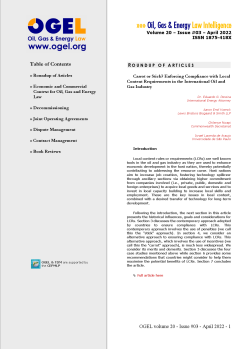
OGEL 3 (2022)
This regular issue of OGEL covers a variety of topics incl. Local Content Requirements, Decommissioning, Brazilian Petroleum Resources, Contractual Flexibility, Joint Venture Agreements, Joint Operating Agreements, several Book Reviews...
-
Editor(s):
Mohamed Rali Badissy
Dr. Tade Oyewunmi
Energy & Natural Resources Law Scholar & Advisor
Penn State Dickinson Law
-
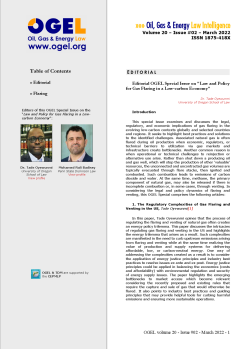
OGEL 2 (2022) - Law and Policy for Gas Flaring in a Low-carbon Economy
This OGEL Special Issue examines and discusses the legal, regulatory, and economic implications of gas flaring in the evolving low-carbon and seeks to highlight best practices and solutions to the identified challenges.
Editors: Dr. Tade Oyewunmi (University of Oregon School of Law) and Mohamed Rali Badissy, (Penn State Dickinson Law).
Table of contents - Law and Policy for Gas Flaring in a Low-carbon Economy
-
Editor(s):
Professor Kim Talus
Prof. Dr. Leigh Hancher
Tilburg Law School and TILEC, Tilburg University
CCEEL, UEF Law School, University of Eastern Finland (UEF)
-
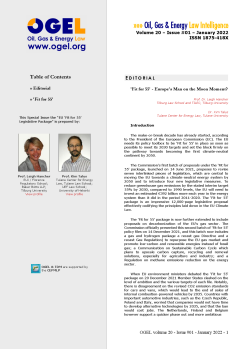
OGEL 1 (2022) - The EU Fit for 55 Legislative Package
This OGEL Special Issue covers all four categories (pricing, targets, standards and support measures) of "The 'EU Fit for 55' Legislative Package". Editors: Prof. Leigh Hancher and Prof. Kim Talus
2021
-
Editor(s):
Professor Tina Soliman Hunter
Dr Theophilus Acheampong
Energy Economist & Political Risk Analyst
Macquarie Law School, Macquarie University
-
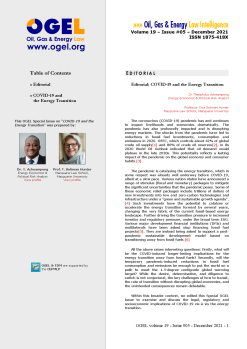
OGEL 5 (2021) - COVID-19 and the Energy Transition
This Special OGEL Issue examines and discuss the legal, regulatory and socioeconomic implications of COVID-19 vis-à-vis the energy transition. Editors: Dr.Theophilus Acheampong & Professor Tina Soliman Hunter. It considers the following topics and themes: (1) global energy transition implications and possible transition pathways for developed and emerging economies - for example, domestic (diversification and job creation) and external drivers (low demand for oil, stalling of fossil-based investments, among others); (2) how the energy transition will play out at regional and national levels; (3) strategic options for countries concerning resource exploration and extraction policies; and (4) policy responses and initiatives by governments to attract investment inflows into the energy sector post-COVID, among others.
-
-
OGEL 4 (2021)
This regular issue of OGEL covers a variety of topics including GATS Schedules, Fair Market Value, The Texas Energy Crisis 2021, Oil Spills, Long-Term Sales and Purchase Contracts, an In Memoriam, and more...
-
-
OGEL 3 (2021) - Review of the Energy Sector in Ghana
After our special on emerging oil producer Guyana, we're pleased to publish this special issue reviewing the Energy sector in Ghana. Many thanks to the contributing authors and various members of the OGEL editorial team for their assistance in preparing this issue, most notably Ms Svanikier Ayensu and Dr. Obeng-Darko.
-
Editor(s):
Dr. Moritz Wüstenberg
Dr. Cameron Kelly
Australian Renewable Energy Agency (ARENA)
Dr. Sirja-Leena Penttinen
CCEEL, UEF Law School, University of Eastern Finland (UEF)
Professor Kim Talus
CCEEL, UEF Law School, University of Eastern Finland (UEF)
-
OGEL 2 (2021) - The Hydrogen Economy
This Special addresses the opportunities for Hydrogen from both demand and supply - side perspectives, across several jurisdictions, including the European Union, Germany, the United Kingdom, Russia, Australia, Japan, Canada and the USA.
-
Editor(s):
Dr. Nana Asare Obeng-Darko
University of Lapland
-
OGEL 1 (2021) - Energy Transitions
This Special is targeted to providing insights that address the most compelling issues associated with energy transitions through law and policy and covers a wide range of issues. Editor: Dr. Nana Asare Obeng-Darko
2020
-
Editor(s):
Professor Kim Talus
Thomas J. Dimitroff
Infrastructure Development Partnership LLP
CCEEL, UEF Law School, University of Eastern Finland (UEF)
-
OGEL 6 (2020) - Law and Policy of Energy Storage
This issue provide perspectives on policies and on legal and regulatory developments targeted to support investment in renewables and storage from the UK, the US, Europe and Australia. Editors: Thomas J. Dimitroff and Kim Talus.
-
Editor(s):
Professor Kim Talus
Gerald Pachoud
Pluto advisory
CCEEL, UEF Law School, University of Eastern Finland (UEF)
-
OGEL 5 (2020) - Environmental, Social and Governance (ESG)
One of the greatest challenges to the oil and gas industry today include the emerging Environmental, Social and Governance (ESG) related rules and regulations as demonstrated by new ESG requirements in most of the home states of major energy companies. Editors: G. Pachoud and K. Talus.
Table of contents - Environmental, Social and Governance (ESG)
-
-
OGEL 4 (2020)
This regular issue of OGEL covers a variety of topics including Decommissioning, Corruption, Iraq, Liquefied Natural Gas (LNG), the Energy Charter Treaty, Climate Change, Economic and Commercial Context for Oil, Gas and Energy Law and more...
-
Editor(s):
Agnieszka Ason
-
OGEL 3 (2020) - Changing LNG Markets and Contracts
This Special collects insights on the recent developments in the global LNG industry, including the COVID-19 outbreak, which added an unexpected angle to the issue. The articles cover (i) LNG markets, (ii) LNG contracts, and (iii) book reviews.
Editor: Agnieszka Ason.
-
Editor(s):
Aaron M. Cooper
Dr. Daria Shapovalova
University of Aberdeen
Coventry University
-
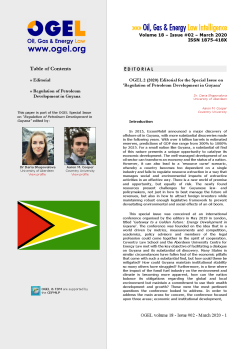
OGEL 2 (2020) - Regulation of Petroleum Development in Guyana
Daria Shapovalova & Aaron Cooper organised a conference in May 2019 (London, UK) and now follow up with this special issue addressing some of the more pressing questions arising from the upcoming oil boom in Guyana.
Table of contents - Regulation of Petroleum Development in Guyana
-
Editor(s):
Dr. Gokce Mete
Dr. Jędrzej Górski
City University of Hong Kong
Vattenfall
Hon. Christine Trenorden
UCL Australia
-
OGEL 1 (2020) - Social Licence to Operate (SLO) in the Extractive and Energy Sectors
The concept of Social Licence to Operate originated in the mining industry and its use has also been extended over large infrastructure, energy, and industrial projects.
The papers in this Special Issue have been grouped into sections to 1) conceptualization of the SLO, 2) intersections between SLO and protection of investment, 3) regional perspectives, 4) case and sector studies, 5) outer space, and 6) one book review.
Editors: J. Górski, G. Mete, and Hon. C. Trenorden.
Table of contents - Social Licence to Operate (SLO) in the Extractive and Energy Sectors
2019
-
Editor(s):
Professor Kim Talus
Thomas J. Dimitroff
Infrastructure Development Partnership LLP
CCEEL, UEF Law School, University of Eastern Finland (UEF)
-
OGEL 5 (2019) - Natural Gas Pipeline Construction and Regulation
This issue is targeted to provide insights into the most current developments within the three most important gas pipeline markets (the US, China and the EU) as well as by providing insights into the regulation of pipeline development in frontier markets. Editors: T.J. Dimitroff & K. Talus
Table of contents - Natural Gas Pipeline Construction and Regulation
-
Editor(s):
Prof. Dr. Yannick Radi
Ana Gerdau de Borja Mercereau
Derains & Gharavi
Université catholique de Louvain
-
OGEL 4 (2019) - OGEL/TDM Special Issue: FDI Operations and Investment Disputes in the African Extractive Sector...
International investment agreements have played a key role in Africa's development. African States are party to numerous bilateral and multilateral investment treaties which have traditionally offered protection to foreign investors and which have permitted recourse to arbitration to settle investment disputes, under the auspices of the ICSID, or similar fora. African States increasingly participate in investment arbitration with foreign investors challenging the legality of regulatory measures in various areas. The Special issue sheds light on the protection of foreign investors in the African extractive sector and on the protection of numerous 'public interests' at stake in this sector. Thereby it seeks to contribute to a better understanding of the challenges raised by FDI operations in the African extractive sector and of their contribution to Africa's development and growth.
The papers in this Special Issue are based on presentations given at the conference held on 14 December 2017 in the Dubai International Arbitration Centre.
Lead editors of this Special Issue: Dr. Ana Gerdau de Borja Mercereau (Derains & Gharavi) and Prof. Dr. Yannick Radi (University of Louvain).
Conveners of the conference: Dr. Jean-Baptiste Harelimana (African Academy of International Law practice); Prof. Dr. Yannick Radi; and Dr. Ana Gerdau de Borja Mercereau.
-
Editor(s):
Dr. Kaisa Huhta
Giuseppe Bellantuono
University of Trento
UEF Law School, University of Eastern Finland
-
OGEL 3 (2019) - The Energy Union in the Next Decade
This issue focuses on the next decade of the Energy Union and goes beyond the analysis of specific provisions and puts the legal developments taking place in EU energy and climate law in a broader perspective. Editors: Prof. Giuseppe Bellantuono and Dr. Kaisa Huhta.
-
-
OGEL 2 (2019)
This first regular issue of OGEL in 2019 covers a variety of topics including Gas, Petroleum Agreements, and other Contracts, Unitization, Venezuela's Petro, the EU Gas Market, Nuclear Energy, the Energy Charter Treaty and more...
-
Editor(s):
Dr. Penelope Crossley
Professor Raphael J. Heffron
University of the West Indies, St. Augustine Campus
Sydney Law School, University of Sydney
Dr. Tade Oyewunmi
Energy & Natural Resources Law Scholar & Advisor
-
OGEL 1 (2019) - Energy Law and Regulation in Low-carbon and Transitional Energy Markets
Editors Raphael J. Heffron, Penelope Crossley, and Tade Oyewunmi prepared this special issue aiming at inspiring contributions to the debates about the role of energy law, policy and regulation in managing the costs and benefits of the global transition towards low-carbon energy systems and markets.
Table of contents - Energy Law and Regulation in Low-carbon and Transitional Energy Markets
2018
-
Editor(s):
Marily Paralika
Alison R. Pearsall
Fieldfisher
-
OGEL 5 (2018) - OGEL/TDM/ArbitralWomen - Strategic Considerations in Energy Disputes
The last issue of 2018 is a joint OGEL/TDM Special Issue with ArbitralWomen on "Strategic Considerations in Energy Disputes" examining new trends, developments, and challenges in the field of energy disputes. Editors: ArbitralWomen Board Members Alison Pearsall. Esq. and Marily Paralika.
Table of contents - OGEL/TDM/ArbitralWomen - Strategic Considerations in Energy Disputes
-
-
OGEL 4 (2018)
This second regular issue of OGEL in 2018 covers a variety of topics including Africa, Shale Gas, Power-to-Gas, LNG, Pipelines, Renewable Energy, Taxation, Investor-State Disputes, the Energy Charter Treaty and more...
-
Editor(s):
Professor Raphael J. Heffron
Professor Kim Talus
CCEEL, UEF Law School, University of Eastern Finland (UEF)
University of the West Indies, St. Augustine Campus
-
OGEL 3 (2018) - International Energy Law
The issue edited by Kim Talus and Raphael Heffron provides an overview of legal and regulatory issues affecting all parts of the energy value chain, from upstream to downstream, providing a comprehensive overview of what "international energy law" is.
-
Editor(s):
Professor Tina Soliman Hunter
Dr. Alexandra Wawryk
University of Adelaide
Macquarie Law School, Macquarie University
-
OGEL 2 (2018) - Decommissioning Offshore Energy Installations
In this Special Issue guest editors Dr Alex Wawryk (University of Adelaide) and Professor Tina Hunter (University of Aberdeen) explore the breadth and depth of scholarship relating to the decommissioning of offshore energy installations.
Table of contents - Decommissioning Offshore Energy Installations
-
-
OGEL 1 (2018)
After a series of OGEL specials in 2017, we hereby publish a regular issue which covers a variety of topics, including a look at Impact and Benefit Agreements, Nord Stream 2, EU Electricity Law, Russian Energy, the Energy Charter Treaty and more...
2017
-
Editor(s):
Professor Kim Talus
Dr. Aikaterini Florou
CCEEL, UEF Law School, University of Eastern Finland (UEF)
-
OGEL 4 (2017) - Liquefied Natural Gas (LNG)
International LNG markets are set for major change, with substantial new liquefaction capacity coming on stream in the period to 2020 and this issue aims precisely at addressing the most topical legal matters relating to LNG production and trading. Editors: Katerini Florou and Kim Talus.
-
Editor(s):
Yanal Abul Failat
Professor Dr. A.F.M. Maniruzzaman
University of Portsmouth
Al Tamimi and Company
-
OGEL 3 (2017) - Energy Law and Policy in the Middle East and North Africa (MENA)
Guest editors Prof. A.F.M. Maniruzzaman and Yanal Abul-Failat focused their MENA special on the region which has been the leading global energy supplier for decades. But the geopolitics of energy is gradually shifting its course and the region's traditional energy power base is being constantly challenged.
Table of contents - Energy Law and Policy in the Middle East and North Africa (MENA)
-
Editor(s):
Dr. A.F. Alhajji
www.anasalhajji.com
-
OGEL 2 (2017) - Brexit
This OGEL Brexit special offers a first look at the impact of the departure of the United Kingdom from the European Union on energy related issues with a focus on cost of energy supply, security of energy supply, and new agreements. Guest editor: Dr. Anas Alhajji.
-
Editor(s):
Dr. Tade Oyewunmi
Professor Yinka Omorogbe
Nigerian Institute of Advanced Legal Studies
Energy & Natural Resources Law Scholar & Advisor
-
OGEL 1 (2017) - Oil and Gas Law and Policy in West Africa
Guest editors Prof. Yinka Omorogbe & Tade Oyewunmi focused their special on Sub-Saharan Africa which has witnessed a surge in oil & gas activity within the past decade, positioning the region as an important contributor in the global energy supply and demand dynamics...
Table of contents - Oil and Gas Law and Policy in West Africa
2016
-
-
OGEL 4 (2016)
After a series of OGEL specials in 2016, we hereby publish the regular issue of this year which covers a variety of topics, including a look at various issues related to Russia (Yukos, Ukraine, Gas Export), various papers from and about Africa and "Oil Price" columns ...
-
Editor(s):
Topi Turunen
Professor Kim Talus
CCEEL, UEF Law School, University of Eastern Finland (UEF)
UEF Law School, University of Eastern Finland (UEF)
-
OGEL 3 (2016) - Waste-to-Energy (WtE)
Waste-to-Energy (WtE) is becoming an increasingly important way to reduce dependence on fossil fuels, landfilling, reduce Greenhouse gas emissions, preserve imported fuels and grow the self-sufficiency of energy production on national level.
The issue contains contributions from academics and practitioners from Europe, covering issues such as the legal definitions in waste-to-energy production, public acceptance of waste-to-energy operations and national overviews on waste-to-energy laws and policies.
-
Editor(s):
Professor Tina Soliman Hunter
Macquarie Law School, Macquarie University
-
OGEL 2 (2016) - Emerging Issues in Polar Energy Law and Governance
Prepared by Dr Tina Hunter (Aberdeen University Centre for Energy Law) this special on Emerging Issues in Polar Energy Law and Governance provides a up-to-date analysis of many aspects of a rapidly changing region, and the legal issues that dominate the Polar regions.
Table of contents - Emerging Issues in Polar Energy Law and Governance
-
Editor(s):
Professor Owen L. Anderson
KBH Energy Center for Business, Law, and Policy, University of Texas School of Law
-
OGEL 1 (2016) - Mexico's Oil and Gas Sector Reform
This special will surely contribute to help readers understand the transition that is currently taking place in the Mexican energy sector as Professor Anderson states in his introduction: "Mexico has undertaken a wholesale reform of its petroleum sector. New constitutional provisions, new laws, new regulations, new contracts, and a new framework—all to the end of creating a modern petroleum regime that will be attractive to investors. The speed, complexity, and thoroughness of these reforms in truly remarkable."
2015
-
-
OGEL 6 (2015)
After a series of OGEL specials in 2015, we hereby publish the last issue of the year which covers a variety of topics, including a look at The Energy Charter Treaty, The Energy Community, various papers from and about Africa and Latin America, Energy Security and other topics of interest.
-
Editor(s):
Mark Kantor
www.mark-kantor.com
-
OGEL 5 (2015) - Yukos Special
Few things can concentrate the mind as much as an award of $50 billion dollars. When the three parallel awards in the Yukos dispute were released in mid-2014, TDM and OGEL therefore immediately called for papers to comprise a Special Issue. Our range of topics includes discussions of the legal aspects and computation of the record-setting damages award; and the attention-getting rulings in the arbitrations on contributory fault, the treatment in the Awards of the Russian tax regime, and the acceptance by the tribunal of illegally-obtained evidence; the terms on which the Yukos awards may be enforced in Russia and England; the damages aspects of the Awards. We have "advance published" those very useful papers, to assure TDM and OGEL readers access to timely observations on various aspects of the largest international arbitration awards we have yet to see. And we are now presenting these papers formally as our Special Issue on the Yukos Awards.
-
Editor(s):
Dr. Knut Olsen
Knut Olsen Global Tax Consultant
-
OGEL 4 (2015) - International Taxation in the Energy Sector
It is now eleven years since the founding editor, Thomas W. Wälde, edited OGEL's first special issue on taxation and his opening statement at that time was that the taxation of oil, gas and energy had become a very specialised business. The message back then was that taxation in the energy sector was complex, with very difficult tax questions, ongoing tax disputes, complex interactions between national tax legislation and operating contracts and the absence of in-depth examination of topics like decommissioning. Since then, the tax climate has been changing - for the worse. Multinational corporations are exposed to sky-high tax risks internationally and the cumulative risks are increasing day by day.
Table of contents - International Taxation in the Energy Sector
-
Editor(s):
Professor Kim Talus
CCEEL, UEF Law School, University of Eastern Finland (UEF)
-
OGEL 3 (2015) - Renewable Energy Disputes
This joint OGEL and TDM Special issue focuses on renewable energy disputes at the level of international, European and national law. There are many ongoing cases at all three levels. Recent and ongoing renewable energy disputes under international law have concerned international investment law and WTO law. Recent renewable energy disputes at European level have mostly related to the free movement provisions of EU Treaty law. Contractual arrangements and connection issues serve as illustrations of private and contractual disputes in these areas at national level....
-
Editor(s):
Piotr Pszczel
Michal Domagla
John Paul II Catholic University of Lublin
-
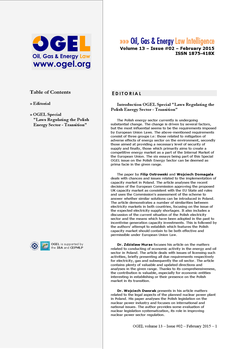
OGEL 2 (2015) - Laws Regulating the Polish Energy Sector - Transition
This OGEL special looks at the Polish energy sector which is currently undergoing substantial change. The change is driven by several factors, but the most influential seems to be the requirements imposed by European Union Laws. The above-mentioned requirements consist of three groups i.e: those related to mitigation of adverse effects of energy sector on the environment, secondly those aimed at providing a necessary level of security of supply and finally, those which primarily aims to create a competitive energy market as a part of the Internal Market of the European Union.
Table of contents - Laws Regulating the Polish Energy Sector - Transition
-
Editor(s):
Professor Kim Talus
Dr. Eduardo G. Pereira
International Energy Attorney
CCEEL, UEF Law School, University of Eastern Finland (UEF)
-
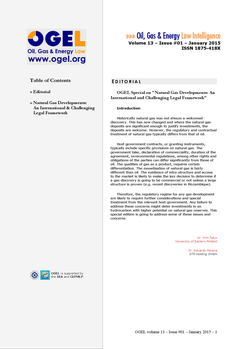
OGEL 1 (2015) - Natural Gas Developments: An International and Challenging Legal Framework
OGEL 1 (2015) is our special on "Natural Gas Developments: An International and Challenging Legal Framework". Historically natural gas was not always a welcomed discovery. This has now changed and where the natural gas deposits are significant enough to justify investments, the deposits are welcome. However, the regulatory and contractual treatment of natural gas typically differs from that of oil. This special explores some of these differences.
Table of contents - Natural Gas Developments: An International and Challenging Legal Framework
2014
-
-
OGEL 4 (2014)
After three OGEL specials in 2014 - including the special on "Governance of Unconventional Gas outside the United States of America" and the World Bank Institute Learning Symposium in June 2014 - we continue 2014 with this regular issue which covers a variety of topics, including a look at the "Eastern Mediterranean Oil and Gas" and the Geopolitics of Energy and the EU/Russia relation and other topics of interest.
-
Editor(s):
Dr. Philip Andrews-Speed
Energy Studies Institute of the National University of Singapore
-
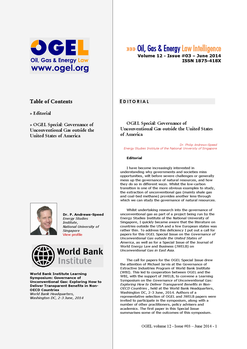
OGEL 3 (2014) - OGEL Special: Governance of Unconventional Gas outside the United States of America
This OGEL Special Issue on the Governance of Unconventional Gas outside the United States of America is edited by OGEL's Editorial Committee member Dr. Philip Andrews-Speed (Energy Studies Institute of the National University of Singapore). The diversity of geography, political context and perspective will provide a good insight into the complexity and diversity of the challenges involved in the governance of unconventional gas. Not only did the contributing authors prepare their papers for this special, but many of them had the opportunity to present their work during a joint OGEL - World Bank Institute (WBI) learning symposium.
-
Editor(s):
Dr. Dirk Buschle
Energy Community Secretariat
-
OGEL 2 (2014) - Energy Community
Energy Community is the primary instrument in EU external energy policy. The large number of contributions to this special on the Energy Community edited by Dr Dirk Buschle (Deputy Director and Head of Legal of the Energy Community Secretariat) illustrate the diversity and complexity of the topic. Instead of providing a coherent account of where the Energy Community stands today, this special provides numerous tie-ins for the future debate. It provides for an inspiring reading on the current issues and future options for the Energy Community. We are comfortable that this special issue will provide the basis for many fruitful discussions. OGEL would like to take this opportunity to thank Dr. Buschle and his colleagues at the Energy Community for their time and effort during the preparation of this special.
-
Editor(s):
Dr. Sergei V. Vinogradov
Simon Amaduobogha
Niger Delta University
CEPMLP, University of Dundee
-
OGEL 1 (2014) - Special: Offshore Petroleum Exploration and Production: Challenges and Responses
This special on Offshore Petroleum Exploration and Production: Challenges and Responses edited by Simon Amaduobogha and Dr. Sergei V. Vinogradov of the Centre for Energy, Petroleum, Mineral Law and Policy (CEPMLP), University of Dundee. It addresses the legal, economic, environmental and policy aspects of offshore exploration and production activities. The editorial provides an overview of the various contributions in this issue.
Table of contents - Special: Offshore Petroleum Exploration and Production: Challenges and Responses
2013
-
-
OGEL 5 (2013)
After four OGEL specials in 2013, we continue 2013 with this regular issue which covers a variety of topics, including a look at Brazilian Production Sharing Agreements (1st Production Sharing Bidding currently underway) and Prof. Dr. Andrey A. Konoplyanik shares his views on the antimonopoly investigation by the European Commission against Gazprom.
-
Editor(s):
Dr. Eduardo G. Pereira
International Energy Attorney
-
OGEL 4 (2013) - Joint Operating Agreements & National Oil Companies: Challenges and Dynamics
This special feature on Joint Operating Agreements & National Oil Companies: Challenges and Dynamics was edited by Dr. Eduardo Pereira (STR Holding). Recent changes in local laws in various countries set requirements for National Oil Companies (NOC) participation in oil and gas projects as "partners". As a result Joint Operating Agreements (JOA) currently often have a NOC as a party to the agreement, this makes the JOA acquire certain specific characteristics. This special edition addresses the key issues between a International Oil Company (IOC) and NOC within a JOA.
Table of contents - Joint Operating Agreements & National Oil Companies: Challenges and Dynamics
-
Editor(s):
Professor Kim Talus
CCEEL, UEF Law School, University of Eastern Finland (UEF)
-
OGEL 3 (2013) - Eastern Mediterranean Oil and Gas
The Eastern Mediterranean basin has become one of the latest areas of interest for the international oil and gas industry. The offshore fields in the area have great potential both in terms of economic activities and progress in the region as well as on an international political level. The objective of this special is to provide a picture of legal and regulatory issues involved and the "state of play" in the new oil and gas region. By drawing on a number of experts within and beyond the countries of the Eastern Mediterranean, the Special issue delivers on the objective.
-
Editor(s):
Dr. Leon Moller
Mirian Kene Kachikwu
The Robert Gordon University, Department of Law
-
OGEL 2 (2013) - Risks and Responses to Risk in the Energy Sector
Mirian Kene Kachikwu and Dr. Leon Moller (Robert Gordon University) edited this OGEL Special on Risks and Responses to Risk in the Energy Sector. It focuses on a number of key risks areas that are facing the international industry today. A number of topical papers are included ranging from academic to industry professionals, covering a wide range of issues in the subject area.
Table of contents - Risks and Responses to Risk in the Energy Sector
-
Editor(s):
Dr. Rudiger Tscherning
Paul Rice
Pinsent Masons LLP
Faculty of Law, University of Calgary
-
OGEL 1 (2013) - Nuclear Law and Policy
Rudiger Tscherning and Paul Rice edited this OGEL Special on Nuclear Law and Policy. The editors brought up the idea for a special during the Future Energy Summit held at Qatar University in May 2012. On the back of intense and varied discussions on nuclear new build programmes, they decided that global developments on nuclear energy, and their legal and policy responses, called for a dedicated issue of the OGEL Journal.
2012
-
-
OGEL 5 (2012)
After four OGEL specials in 2012, we continue 2012 with this regular issue which overs a variety of topics, including a number of papers looking at Unconventional Oil & Gas - one of which was awarded the D. Francis Bustin Prize - a look at India's Massive Grid Collapse of August 2012; China and several book reviews.
-
Editor(s):
Professor Peter D. Cameron
Centre for Energy, Petroleum and Mineral Law & Policy (CEPMLP)
-
OGEL 4 (2012) - The Interface between EU Energy, Environmental and Competition Law - A Survey
This OGEL Mini Special examines the Interface between EU Energy, Environmental and Competition Law. The articles approach these topic from various country perspectives (Finland, Denmark, the Netherlands, the United Kingdom and Spain). It responds to questions relating to the role of sector-specific energy regulation and general competition law, and it examines the sometimes uneasy relationship between competition, security and promotion of green energy production. It also covers Treaty amendments and developments in both the sector regulation and the case law, and includes issues on climate change, energy trading, and security of supply. Also included is a book published by Herbert Smith entitled "The European Energy Handbook 2012" edited by Mark Newbery and Silke Goldberg.
Table of contents - The Interface between EU Energy, Environmental and Competition Law - A Survey
-
Editor(s):
Professor Kim Talus
CCEEL, UEF Law School, University of Eastern Finland (UEF)
-
OGEL 3 (2012) - OGEL Ten Years Special Issue: Internationalisation of Energy Law
We are pleased to publish the 10-year special issue of OGEL. Founding editor of OGEL Thomas W. Wälde, wrote in his first editorial: "Oil-gas-energy law (OGEL) has over the last decade transcended national borders. With privatisation, restructuring, the emergence of competitive markets, cross-border energy trade and regional integration, legal instruments from one jurisdiction (countries; international organisations; professional and industry associations; civil society forums, internal corporate codes) have a bearing on others - they provide a model, a legal precedent, a directive, standard or guideline for further regulatory implementation." ... Much has changed in ten years but the trend identified by Thomas W. Wälde in his first editorial still continues to develop.
Table of contents - OGEL Ten Years Special Issue: Internationalisation of Energy Law
-
Editor(s):
James Lloyd Loftis
Adrianne L. Goins
Vinson & Elkins
Vinson & Elkins
Timothy J. Tyler
Norton Rose Fulbright
-
OGEL 2 (2012) - Arctic Region: Boundaries, Resources and the Promise of Co-operation
The articles in this Arctic Region: Boundaries, Resources and the Promise of Co-operation OGEL special address several areas essential to understanding current and future Arctic issues: - The legal regime, maritime boundary delimitation, and dispute resolution; - The geopolitics of Arctic developments; - The economics of oil and gas exploration in the Arctic; and The environmental issues associated with resource management and development in the Arctic.
Edited by James Lloyd Loftis, Timothy J. Tyler and Adrianne Goins of Vinson & Elkins LLP this special is surely a valuable contribution to the ongoing international discussion about Arctic issues.Table of contents - Arctic Region: Boundaries, Resources and the Promise of Co-operation
-
Editor(s):
Dr. Jacques Werner
Arif Hyder Ali
Dechert LLP
-
OGEL 1 (2012) - A Liber Amicorum: Thomas Wälde - Law Beyond Conventional Thought
A Liber Amicorum: Thomas Wälde - Law Beyond Conventional Thought was published in 2009 by CMP Publishing Ltd. in honour of Thomas Wälde. The editors Jacques Werner and Arif Hyder Ali gathered an impressive collection of essays by practitioners, arbitrators and professors who knew Thomas Wälde in a modest effort to capture Thomas' never ending interests. This book is now available on OGEL and TDM with the kind permission from the publisher. For subscribers the chapters are available as individual papers, all others may download the entire book as a free download.
Table of contents - A Liber Amicorum: Thomas Wälde - Law Beyond Conventional Thought
2011
-
-
OGEL 6 (2011)
This third regular issue of 2011 is the last of our six issues published in 2011 and covers - as usual - a variety of topics with follow up material from previous specials such as Host Government Contracts in the Upstream Oil and Gas Sector; Oil Spills; Comparative Energy Law; etc. and other papers of general interest.
-
-
OGEL 5 (2011)
This regular issue covers a variety of topics including The Energy Charter Treaty, Electricity, EU Energy, a series of China columns and a number of book reviews.
-
Editor(s):
Denis A. Fallon
Kenneth S. (Ken) Culotta
Willkie Farr & Gallagher LLP
John L. Southalan
The University of Western Australia
-
OGEL 4 (2011) - Indigenous People and Resources Development
The legal significance of the interaction of resource development and indigenous peoples has increased over recent years. There has been considerable jurisprudence and regulation in the area, both internationally and within many countries, making it timely for an OGEL special issue to examine the contemporary state of the law. In the editorial the editors John L. Southalan (Yamatji Marlpa Aboriginal Corporation), Ken Culotta and Archie Fallon (King & Spalding) summarise the articles in this special issue but also provide a broader overview.
Table of contents - Indigenous People and Resources Development
-
Editor(s):
Dr. Sergei V. Vinogradov
Dr. Ishrak Ahmed Siddiky
CEPMLP, University of Dundee
-
OGEL 3 (2011) - Cross-Border Pipelines
International attention to the issues concerning cross-border pipelines has been on the rise over the last decade. The number of cross-border oil and gas pipeline projects recently completed or being currently developed, planned or discussed is continuously growing, mostly as a result of the increased concerns about security of energy supply, demand and diversification. The aim of this OGEL special issue is to promote the debate about cross-border pipelines from various perspectives.
This special issue was prepared by Dr. Ishrak Ahmed Siddiky and Dr. Sergei V. Vinogradov - both of CEPMLP, University of Dundee.
-
Editor(s):
Professor Kim Talus
Giuseppe Bellantuono
University of Trento
CCEEL, UEF Law School, University of Eastern Finland (UEF)
-
OGEL 2 (2011) - Comparative Energy Law
This Special Issue is devoted to the comparative analysis of regulatory systems in the oil, gas and electricity sectors. By 'comparative' we mean that kind of research which tries to identify similarities and differences among the regulatory systems of different countries or regions. Several reasons explain why comparative knowledge is of primary importance in the energy regulators' and energy lawyers' toolbox.
The purpose of this special is to start an academic reflection on the advantages of a comparative approach for energy law and policy. Hopefully, this Special Issue will foster a dialogue on how to carry out comparative research and increase its relevance for everyday legal practice in the energy sector. In the coming years OGEL will be eager to host additional contributions which adopt a comparative perspective.
-
-
OGEL 1 (2011)
After the four specials we published in 2010 we kick of 2011 with a regular issue covering a variety of topics that are at the heart of the contemporary energy discussions around the world. One central theme of this issue is that of natural gas pricing in the EU natural gas trade. Articles from some of the leading experts in this area, Professor Jonathan Stern and Dr. Andrey Konoplyanik provide for a comprehensive overview of the currently discussed issues.
2010
-
Editor(s):
James C. Sonnier
Steven P. Otillar
White & Case
Enbridge Energy
-
OGEL 4 (2010) - Host Government Contracts in the Upstream Oil and Gas Sector
In light of new and developing mechanisms such as windfall profits taxes, compulsory service agreements and joint venture operations, increased use of price-linked fiscal terms as opposed to R-factor formulas, and limitations on reimbursement through cost oil and depreciation allowances, OGEL felt it was time to have an international survey of various fiscal regimes, including an effort to examine the current balance of power between international oil companies ("IOC"), national oil companies ("NOC") and host governments. This issue has endeavored to find experts not only drafting from an international perspective, but hopefully finding those elements within various host governments experiencing changes in their E&P regimes and host government contracting strategies to tell us their opinion from a domestic practitioner's point of view.
Table of contents - Host Government Contracts in the Upstream Oil and Gas Sector
-
Editor(s):
Professor John S. Lowe
Professor Owen L. Anderson
KBH Energy Center for Business, Law, and Policy, University of Texas School of Law
SMU Dedman School of Law
-
OGEL 3 (2010) - Oil Spills
For the world-wide petroleum industry, the spring and summer of 2010, which could have been remembered as the beginning of the process to open more offshore areas of the United States to oil and gas exploration, will instead be remembered as the time of the BP oil spill.
In this OGEL Special on Oil Spills we take a first look at the implications of this accident and the legal, contractual and regulatory issues of oil spills in various countries.
-
Editor(s):
Rashid Gaissin
Zulfiya Akchurina
GRATA Law Firm
Armstrong Teasdale
-
OGEL 2 (2010) - Kazakhstan
Kazakhstan attracts considerable attention from the world energy stakeholders and players with its abundant energy resources and supplies and is in the process of modernising its legal system. Topics addressed in this issue include a review of the draft law on subsurface and subsurface use, PSAs, arbitration, renewable energy, environmental issues, CSR, and other articles discussing various new laws and regulations.
-
Editor(s):
Professor Nicolas Petit
University of Liège
-
OGEL 1 (2010) - Antitrust in the Energy Sector
This Special OGEL issue on "Antitrust in the energy sector" is devoted to the challenges arising from the implementation of the antitrust laws across various energy sectors. While this Special spans a range of countries, its primary focus is on the European Union ("EU") and the United States ("US"). This is natural considering the strong antitrust law traditions on both sides of the Atlantic, as well as the current leading position of the EU and the US authorities within the global competition community.
2009
-
-
OGEL 4 (2009)
2009 has been an interesting year. In addition to the financial crisis and the ever intensifying efforts to combat climate change, we have also seen significant changes in EU energy law and policy and the ECT process. We have also seen changes in the international natural gas markets followed by the developments in the Brazilian pre-salt area and the US shale gas. These developments continue to have major legal and policy implications. The Caspian region is becoming increasingly important, no least because its significant reserves of natural gas and its location between EU, China and Russia.
-
Editor(s):
Professor Kim Talus
CCEEL, UEF Law School, University of Eastern Finland (UEF)
-
OGEL 3 (2009) - Student special
In this OGEL Student special we tried to give the students an opportunity to have their papers published in OGEL. With contributing students from Bulgaria, Cameroon, China, Finland, Ghana, Germany, Hong Kong, Hungary, Kazakhstan, the Netherlands, Nigeria, Peru, Russia, Taiwan, United Kingdom and United States we were pleasantly surprised by the quality and the range of interest of the students.
We would like to take the opportunity to thank the staff members of various universities such as CEPMLP, University of Aberdeen, University of Houston Law Center and the Higher School of Economics for their assistance in coordinating this special.
-
Editor(s):
Piero Luigi Fratini
-
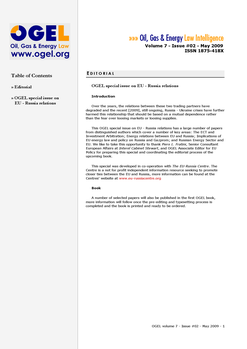
OGEL 2 (2009) - EU - Russia relations
Over the years, the relations between these two trading partners have degraded and the recent [2009], still ongoing, Russia - Ukraine crises have further harmed this relationship that should be based on a mutual dependence rather than the fear over loosing markets or loosing supplies.
This OGEL special issue on EU - Russia relations has a large number of papers from distinguished authors which cover a number of key areas:
- The ECT and Investment Arbitration;
- Energy relations between EU and Russia;
- Implications of EU energy law and policy on Russia and Gazprom; and
- Russian Energy Sector and EU.
This special was developed in co-operation with The EU-Russia Centre. The Centre is a not for profit independent information resource seeking to promote closer ties between the EU and Russia, more information can be found at the Centres' website at www.eu-russiacentre.org
-
Editor(s):
Diana Bayzakova
Merritz
-
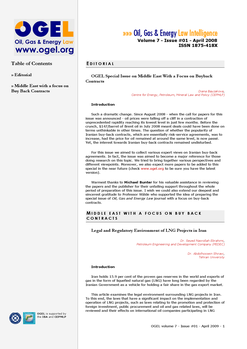
OGEL 1 (2009) - Middle East With a Focus on Buy Back Contracts
This issue of OGEL is a special feature on the Middle East With a Focus on Buy Back Contracts prepared by Diana Bayzakova of CEPMLP. This issue includes a collection of various expert views on Iranian buy-back agreements. Warmest thanks to Michael Bunter for his valuable assistance during the preparation of this special.
Table of contents - Middle East With a Focus on Buy Back Contracts
2008
-
Editor(s):
Matt Stone
Dr. Zhanibek Saurbek
KazMunayGas
St Antony's College
-
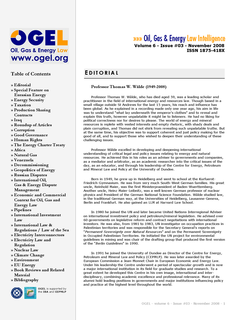
OGEL 3 (2008) - Eurasian Energy
This issue of OGEL has a special feature on Eurasian Energy prepared looking at developments in Kazakhstan, Uzbekistan, Ukraine, Turkmenistan, Russia and the Caspian Region as a whole.
This special issue was prepared by Zhanibek Saurbek, a researcher and doctoral candidate at the CEPMLP, and Matt Stone, a post-graduate also at the CEPMLP.
-
Editor(s):
Elisabeth Eljuri
www.elisabetheljurilaw.com
-
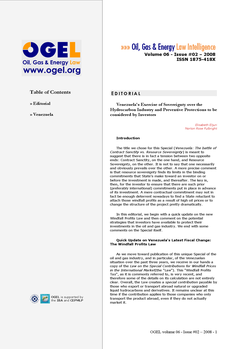
OGEL 2 (2008) - Venezuela: The battle of Contract Sanctity vs. Resource Sovereignty
This OGEL / TDM Special Issue on Venezuela: The battle of Contract Sanctity vs. Resource Sovereignty was prepared by Elisabeth Eljuri, the head of Macleod Dixon's Oil and Gas Department in Caracas, Venezuela. In this Special we have attempted to provide articles on a wide array of topics in the oil and gas as well as the arbitration areas.
Table of contents - Venezuela: The battle of Contract Sanctity vs. Resource Sovereignty
-
Editor(s):
Dr. Xin Ma
Dr. Philip Andrews-Speed
Energy Studies Institute of the National University of Singapore
Total
-
OGEL 1 (2008) - China's Energy and Environmental Challenges
This first issue of OGEL in 2008 is a special issue on "China's Energy and Environmental challenges". Edited by Ms. Xin Ma, a petroleum economist and doctoral candidate at CEPMLP, University of Dundee, this special brings together the views of various specialists in order to help "outsiders" develop a better understanding of the Chinese energy and environmental issues.
Table of contents - China's Energy and Environmental Challenges
2007
-
Editor(s):
Dr. Sanam S. Haghighi
-
OGEL 4 (2007) - Energy Security
OGEL 4 (2007) includes a special feature edited by Dr. Sanam S. Haghighi on "Energy Security" which intends to open an up-to-date debate about energy security while encompassing the current risks, as well as analyzing what this concept means for various players, and what strategies are or should be undertaken by them. Dr. Haghighi recently published the book "Energy Security - The External Legal Relations of the European Union with Major Oil and Gas Supplying Countries" (Hart Publishing - available at a 20% discount for OGEL readers).
-
Editor(s):
Richard E. Walck
Global Financial Analytics LLC
-
OGEL 3 (2007) - Energy Litigation and Arbitration - Expert Perspectives
We are pleased that Richard Walck, Global Financial Analytics LLC, prepared this joint OGEL/TDM Special Issue on "Energy Litigation and Arbitration - Expert Perspectives". In this issue, we try to provide some thoughts on the use of experts in arbitration and litigation. While the stated focus in on the energy sector, some of the authors have written for a more general audience. Some articles are written by the experts; others about them.
Table of contents - Energy Litigation and Arbitration - Expert Perspectives
-
Editor(s):
Dr. Jim Ross
-
OGEL 2 (2007) - Unitisation
OGEL 2 (2007) has a special feature on international unitisation put together by Dr. Jim Ross, a well known and experienced geologist, with additional legal qualifications and a specialty in unitisation consultancy.
The papers contained in this special issue are subdivided to reflect, first, "sole-country" unitisations and legislation, and, second, papers and agreements related to "cross-border" issues. The latter group of papers includes discussion of the recent development of "framework" unitisation agreements, as well as the agreements covering the Greater Sunrise field, a field that crosses the boundary between a JDZ on one side and, on the other side, an area where Australia has exercised sovereign rights pursuant to an earlier delimitation agreement with Indonesia, but which is now subject to a claim by Timor-Leste. If it is possible to achieve agreement on unitisation in such a difficult and complex situation, anything is possible!
-
Editor(s):
Dr. Charles Zimmermann
Professor Kim Talus
CCEEL, UEF Law School, University of Eastern Finland (UEF)
-
OGEL 1 (2007) - Electricity Interconnectors (2nd special)
Charles Zimmermann and Kim Talus have prepared another special on Electricity Interconnectors for our OGEL Journal.
An electric interconnector may be defined as a high-voltage overhead line or undersea cable, and related equipment, used to connect the transmission networks of two countries or to connect the networks of two provinces or states that have separate power systems. In many parts of the world, investment in electric interconnectors will be needed over the next twenty years. Without electric interconnectors, electricity trade would not be possible.
While the first special issue (Volume 4, issue #2, August 2006) focused primarily on EU regulation in this area, this second issue has opted for a broader approach.
Although the majority of the articles have an "EU focus," the key policy issues and investment questions are also associated with interconnectors outside the EU. We would welcome future OGEL articles covering interconnectors in Asia, Africa, Latin America, and the rest of the world.Table of contents - Electricity Interconnectors (2nd special)
2006
-
Editor(s):
Energy Charter
Professor Edmilson Moutinho dos Santos
University of São Paulo
www.encharter.org
Chris Flynn
-
OGEL 4 (2006) - Pipelines
This issue of OGEL has a special feature on pipelines prepared with the help from Professor Edmilson dos Santos (University of São Paulo), Chris Flynn (Ashurst), Dr. Andrei Konoplyanik and his team from the Energy Charter Secretariate, contributions from Global Pipeline Monthly editor John Tiratsoo and a selection of project analyses focusing on pipeline projects from the A&A Energy Security Briefing newsletter.
-
Editor(s):
Bede Onyemaechi Nzenwa Nwete
BP Exploration Operating Company
-
OGEL 3 (2006) - Africa
OGELs' Africa Editor Bede Nwete has prepared this special feature on Africa with a collection of articles on the oil, gas and mineral industry in Africa dealing with such issues as; the role of the African Petroleum Producers' Association, the promotion of petroleum expertise in the continent, and issues of energy financing in Africa. A host of other issues rest on Algeria's new hydrocarbon laws, and the OHADA (Organisation for the Harmonisation of Business Laws in Africa), including ways and manners of dealing with community issues in petroleum and mineral development in the continent.
-
Editor(s):
Dr. Charles Zimmermann
Professor Kim Talus
CCEEL, UEF Law School, University of Eastern Finland (UEF)
-
OGEL 2 (2006) - Electricity Interconnectors
Electricity Interconnectors present serious challenges for both the Community legislator and the enforcer: attracting investment, freeing interconnectors from various encumbrances, securing the supply of energy and creating opportunities for market based competition.
This special issue will also approach these questions from a wider setting and discuss issues such as international energy trade and access to networks or disputes arising from the operation of interconnectors.
Similar issues will no doubt be discussed in the thirteenth meeting of the European Electricity Regulatory Forum in Florence on September 7 and 8, 2006. This special issue of OGEL will serve those who wish to get a complete picture of various issues relating to interconnectors. It will also provide for alternative ways of looking at the problem areas Europe is presently facing.
-
Editor(s):
Philip R. Weems
Stéphane D. Gauducheau
ASC Pty Ltd
-
OGEL 1 (2006) - Liquefied Natural Gas (LNG)
In this issue we have a special feature on Liquefied Natural Gas (LNG). The articles in the special come from authors around the world and relate to import and export terminal projects, shipping and trade issues.
The last 10 years interest in LNG has been growing. For gas exporting nations, LNG is a mean to monetise gas reserves otherwise difficult to access. For European nations and the United States LNG helps to satisfy an ever increasing gas demand.
2005
-
Editor(s):
Professor Dr. A.F.M. Maniruzzaman
University of Portsmouth
-
OGEL 4 (2005) - Asian Energy Law and Policy
We are very pleased that, together with Professor Maniruzzaman from the University of Portsmouth, we have been able to publish the first in a series of Special Features on Asian Energy Law and Policy.
Recent developments in Asia makes it more important than ever before to study energy law and policy in this region of the world.
-
Editor(s):
Veronica Brieno Rankin
GeoSeq International LLC
-
OGEL 3 (2005) - Coal
This OGEL issue follows up on earlier special issues with extended reporting on production-sharing contract and windpower issues. In addition, we are very pleased that we have been able, with our special issue editor, Veronica Brieno Rankin, to put together a special issue on coal.
Coal used to be a "legacy" energy resource; but with the much increased prices for oil and gas, coal has won in attractiveness. That attractiveness is reinforced by two further factors: First, the climate change risks associated with goal are likely to be reduced as new technologies are developed that manage CO2 emissions better; Second, the continued reluctance in particular in EU countries to expand nuclear plants (involving a difficult trade-off between superior climate-change performance and a still unresolved waste decommissioning challenge) means in effect that coal, in particular "clean-coal" may experience a significant come-back.
-
Editor(s):
Carol A. Smoots
Perkins Coie
-
OGEL 2 (2005) - Windpower
In this OGEL issue we focuses on Windpower. Thanks to our contributors and to Carol Smoots of Perkins Coie LLP in Washington, this special issue illustrates both development in windpower, and regulatory, financing, investment and commercial challenges.
Windpower is not the only alternative to oil & gas, but it could well be one essential part in a mix of measures which include energy efficiency, windpower and other renewables, expansion of nuclear and new technologies (carbon sequestration). A future special issue will focus on coal.
-
Editor(s):
Philip R. Weems
Scott C. Craig
Latham & Watkins
-
OGEL 1 (2005) - Production Sharing Contracts
Production-sharing contracts now dominate the world of upstream exploration and development for oil and gas, with some exceptions in Europe (where concession-licenses prevail), in the US and in some Latin American countries which have during their privatisation period in the 1990s re-introduced mineral concessions on the Chilean model (Chile, Argentina, Brazil, Peru in particular). Production-sharing contracts are also used, though sparingly and with limitations, in Russia.
The PSC originated in the 1960s in Indonesia, conceptually and culturally derived from the share-cropping model then familiar to Indonesians (and indeed much of the agricultural world where agricultural leases have traditionally often been based on simple production-sharing). It offered a new model to reject the "mineral concession" then seen as colonialist (though in itself it is nothing but a particular form of a legal title to exploration and subsequent development in case of a commercial discovery); it was made attractive to the then (and now) nationalistic sentiments in producing countries as it did (or seemed to give) the symbolic functions of ownership and control of the resource, both underground and after extraction, to the state enterprise (in Russia the state) as the agent of the nation. It also provided the state with oil in kind to supply domestic needs. To the int'l oil companies, it was first seen as revolutionary and widely resented.
2004
-
Editor(s):
Energy Charter
www.encharter.org
-
OGEL 5 (2004) - Energy Charter Treaty
The Oil, Gas & Energy Law Intelligence (OGEL) publishers are delighted and most honoured with this special feature to celebrate the 10th anniversary of The Energy Charter Treaty.
This issue was prepared by the ECT staff and we would like to thank them for taking on the responsibility for editing this special issue.
The issue concludes with a list of previously published articles on the ECT and articles written by ECT staff.
-
Editor(s):
Ayesha Dias
Christine Batruch
Lundin Group
-
OGEL 4 (2004) - Corporate Social Responsibility (CSR)
OGEL 4 (2004) has a comprehensive special issue on "soft" regulation of oil, gas and energy activities focusing on corporate social responsibility, codes, guidelines, standards and authoritative and influential soft-law rules. Lawyers and regulators in the field have to know the applicable law; but moreover, they now have to be familiar with the emerging, and sometimes difficult to identify, soft-law rules emerging from international organisations, professional associations, "civil society", industry self-regulation and other relevant sources of authority.
These have sometimes a direct legal effect - if incorporated or referred to in "hard" legal instruments such as laws, regulations, treaties and contracts. They also can have an indirect legal effect - such as when they define standards of liability or help to interpret open-ended formulations in international treaties, contracts of regulation. Lastly, they also define the expectations against which companies are measured - expectations that play a role in negotiations with governments, local communities, financing institutions, NGOs or that define the ambiguous concept of the "social license to operate".
-
Editor(s):
Dr. Helder Queiroz Pinto Jr.
Dr. Dominique Finon
CNRS
Universidade Federal do Rio de Janeiro - UFRJ
Professor Angel de la Vega Navarro
Universidad Nacional Autónoma de México (UNAM)
-
OGEL 3 (2004) - Taxation / Latin America
In November 2003 specialists from different disciplines met in Mexico City to debate issues related to energy reforms at an international conference sponsored jointly by the National Autonomous University of Mexico (UNAM), the University of Grenoble and the French Ministry of Foreign Affairs.
The conference objective was to debate reforms in the electricity, oil and gas industries from a historical and institutional perspective. Multiple factors have changed the organisation of the energy industries, but not always in the ways foreseen or anticipated. The conference did not consider privatisation and foreign-investor participation as the only alternative to State monopoly in its evaluation of the inadequacies and defects of industrial organisation. Nor did it advocate a return to the integrated public monopoly, considered as a viable solution.
-
Editor(s):
Dr. Alexandra Wawryk
University of Adelaide
-
OGEL 2 (2004) - Renewable Energy
In this issue OGEL publishes an extensive special feature on renewable energy edited by Dr. Alexandra Wawryk, Lecturer at the Law School of the University of Adelaide in Australia. Dr. Wawryk recently obtained the prestigious Willoughby Prize for an excellent article on environmental standards in the international oil and gas industry in the IBA's Journal of Energy & Natural Resources Law (2002, Vol 20, No 4). This special OGEL feature shows Dr Wawryk's great dedication and ability to deliver on the related issue of renewable energy.
-
Editor(s):
Louise van Schaik
Christian Egenhofer
Centre for European Policy Studies
Clingendael
-
OGEL 1 (2004) - Climate Change
The climate change policies now instituted in pursuit of the Kyoto protocol (mainly in the EU, so far) challenge the primacy of oil and gas. While this is not an issue for the consumers, it is the strategic issue for the main producing countries - and oil and gas producing companies. These are all at present starting to examine the implications of the Kyoto protocol, its demise, modification or expansion as the case may be, of the negotiated accession of Saudi Arabia and Russia to the WTO and of other climate-change related initiatives such as the Bonn 2004 Conference on Promotion of Renewable Energy. This special feature is put together as Guest Editor by Christian Egenhofer (supported by his team), coordinator of the European climate change network, fellow at the influential Centre for European Policy Studies (CEPS) in Brussels and a climate change policy adviser to many governments and international agencies.
2003
-
Editor(s):
Richard Shoylekov
Professor Giacomo Luciani
Paris School of International Affairs
Question 5
-
OGEL 5 (2003) - Corruption / Geopolitics of Oil and Gas
Richard Shoylekov has put together a very interesting and up-to-date Special Section on the Implications of Bribery in the international energy industries.
Bribery is a constant challenge for energy companies: the grant of upstream acreage by license / contract can be of great value and is therefore a natural opportunity for bribery; subcontracting - in particular in case of an obligation to provide domestic procurement in producing countries with a low governance level - is another natural entry for bribery practices. Few established oil companies would ever wish to be involved in bribery; circumstances and competition, however, can act as a driver pushing project managers keen to show a result into actions not condoned by policies designed at corporate headquarters.Professor Giacomo Luciani, formerly a senior corporate strategist for ENI and now professor at the European University Institute in Florence, Italy, organised in 2003 a conference, together with the Aspen Institute, on the geopolitics of energy. The geopolitical context of oil and gas development in particular serves as the foundation for several legal challenges at present - eg the evolution of regulatory, project finance and contractual practices in the budding natural gas sector, the entry into Saudi Arabia (gas), Kuwait (oil) and perhaps at some point Iraq. Professor Luciani has prepared a special section of OGEL on the geopolitical context of oil and gas law.
-
Editor(s):
Peter Storm
Paul Griffin
White & Case LLP
-
OGEL 4 (2003) - Natural Gas
OGEL 4 includes a special section on natural gas, greatly helped by Associate Editors Paul Griffin of Herbert Smith and Peter Storm of DONG / IGU (International Gas Union).
-
Editor(s):
Professor Thomas Wälde (†)
CEPMLP, University of Dundee
-
OGEL 3 (2003) - Energy and Electricity Regulation
A special feature of OGEL 3 is an extensive collection of articles, comments, notes, news and primary legal and official documents in the area of electricity regulation. Electricity used to be a mainly domestic, state-owned and monopolistic industry. But that has changed. Privatisation, de-regulation and competitive markets are emerging almost everywhere, although not without pain. My own advisory team has been heavily involved, not only in legislative reform, but also in several large-scale, complex, cross-border contract and investment disputes, all under the shadow of, sometimes, three moving and disjointed regulatory regimes. Some of the insights gained are reflected in pertinent comments, including from our partners in major law firms.
-
Editor(s):
Professor Thomas Wälde (†)
CEPMLP, University of Dundee
-
OGEL 2 (2003) - Dispute Management in the Oil, Gas and Energy Industries
OGEL 2 contains what in essence is probably the most exhaustive and extensive collection of in-depth analyses, incisive comments, relevant current news, but also primary documents (institutional rules and guidelines; manuals; awards) on the management of disputes in the oil, gas and energy industries.
The special feature quite consciously uses the term 'dispute management' - and not arbitration or dispute resolution in the conventional terms. While we bring a wealth of intelligence on arbitration, this is contrasted with new forms of dispute management, in particular mediation.
My lead comment highlights the management perspective - rather than a more formal, black-letter only discussion of rules and procedures. It is followed by a lively, orchestrated discussion by noted practitioners on the pros and cons - I have rejected only comments that contain the text: 'As Professor Wälde so aptly puts it'.
If this were printed in full, it would be the equivalent of one or several large books. The strategy of OGEL is not just to publish papers, but to show the various facets of a rule, a procedure, an institution and the various experiences and views that professionals in the international oil, gas and energy industries are developing.Table of contents - Dispute Management in the Oil, Gas and Energy Industries
-
-
OGEL 1 (2003)
Why OGEL - an Oil-Gas-Energy Law Intelligence Service?
Introduction
Oil-gas-energy law (OGEL) has over the last decade transcended national borders. With privatisation, restructuring, the emergence of competitive markets, cross-border energy trade and regional integration, legal instruments from one jurisdiction (countries; international organisations; professional and industry associations; civil society forums, internal corporate codes) have a bearing on others - they provide a model, a legal precedent, a directive, standard or guideline for further regulatory implementation.